
Federal BOP Releases Near Worth
No federal prison is identified inside Worth County. The BOP locator still matters when a local arrest became a federal case, a federal sentence followed proceedings connected with Worth County, or a person was transferred into federal custody. A Worth County Jail record may describe that event as a transfer or release to another authority. That entry is not a community release.
BOP covers people incarcerated in the federal prison system from 1982 to the present. It does not cover an ordinary county charge, a Georgia state sentence, every person held for the U.S. Marshals Service, or ICE detention. A federal result should be read alongside the local booking record and federal case information when the custody chain began at Worth County Jail.
Confirm a Federal BOP Release
Use the official BOP locator for the federal portion of custody. Search carefully because names may be shared and older records may use a different name form.
- Open the Federal BOP Inmate Locator.
- Search by BOP register number when known. Otherwise use the person's full name and available age, race, and sex filters.
- Compare the identity details and register number with the federal case or transfer record.
- Read the facility and release fields. A listed facility generally points to BOP custody, while a past release date may appear without a current institution.
- If the record says Released or Not in BOP Custody, note exactly which wording and date appear.
- Check whether USMS, ICE, state, county, probation, or supervised-release authority continued after BOP custody.
The Worth County release-record paths help reconstruct the local part of a transfer. Use the Sheriff's previous-inmate search or request the release and transfer entry when the county roster is incomplete.
Read BOP Release Status Correctly
BOP explains that when the listed release date is in the past and no facility appears, the person was released from BOP custody on that date. The locator may use “Released” or indicate that the person is not in BOP custody. Both statements have a limited scope. They describe the Bureau's custody, not every legal obligation.
A person can leave BOP and begin federal supervised release. Supervised release is a court-ordered community term handled through the federal probation system. Another agency could also take custody on a warrant, detainer, immigration matter, or state case. The BOP result alone cannot rule those possibilities in or out.
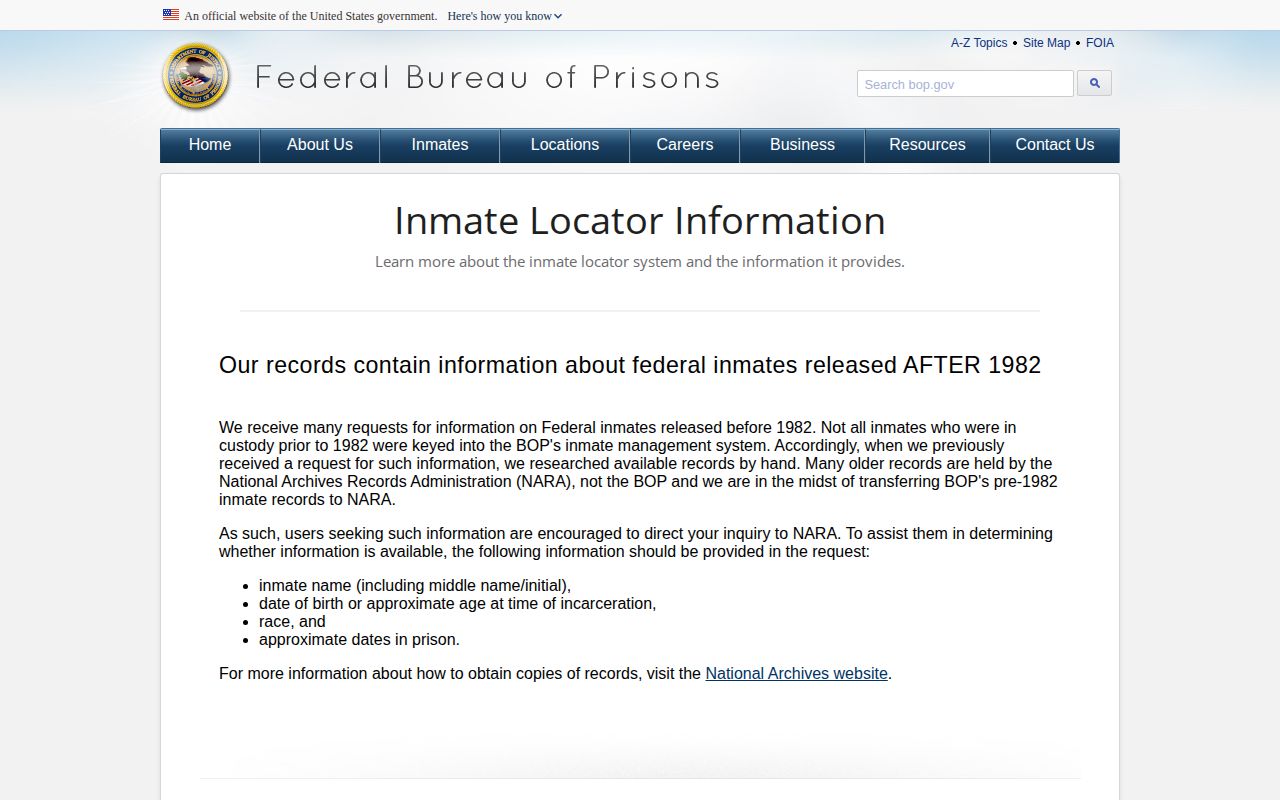
The official BOP locator-record explanation is shown below.
Worth Transfers to Federal Custody
A county release can be the first half of a transfer. Worth County Jail may end its custody when U.S. Marshals, BOP, ICE, GDC, or another county accepts the person. The county release date remains real, but it does not mean the person entered the community.
Start with the Worth record when the person was booked locally. Ask for the booking record, release date and time, release type if maintained, and transfer destination if releasable. The court docket may identify a federal writ or related proceeding. Then use the federal system that fits the next stage.
Do not use the BOP locator merely because an arrest involved a federal agency. Many federal defendants are held under USMS authority before trial and may be housed in a contract or local facility. A BOP record usually becomes the correct route after commitment to a federal sentence.
USMS and BOP Record Differences
The U.S. Marshals Service manages many federal pretrial prisoners and people moving between courts and facilities. After an initial hearing, a defendant may be released or remanded to the Marshal. USMS custody files can therefore fill a gap when no BOP result exists.
For a USMS record, use the agency's Freedom of Information Act channel and identify the person, approximate dates, federal court, and known prisoner number. A response may be limited by exemptions. For a BOP prisoner, the locator and Bureau records are the direct routes. Federal court records may show detention, sentence, release conditions, and supervised release, but the docket is a legal record rather than a live custody locator.
Federal BOP Records and Contact
BOP's public locator is the first contact route and supplies the official search for federal inmates from 1982 onward. No Worth County BOP facility address or local BOP office was identified, so a made-up local contact would be misleading.
Federal Bureau of Prisons
Locator: BOP Inmate Locator
Record guidance: About BOP inmate records
Coverage: Federal Bureau of Prisons custody, 1982 to present
Questions about the Worth County booking still belong to the Sheriff's Office. State custody belongs to GDC. ICE custody belongs to ODLS. Keeping each contact tied to its own custody period avoids treating one agency's negative search as proof about all others.
Federal Release Dates and Supervision
A BOP date is not a county release date and not a Georgia parole date. Federal supervised release follows a federal judgment and differs from parole. The federal court and probation system control that term. Georgia DCS supervises qualifying state parole and felony probation, not a federal supervised-release order.
If a person returns to Worth County after BOP release, the federal status does not create an entry in the county jail roster unless a new county booking occurs. Likewise, absence from OffenderIndex does not confirm the federal release. Use BOP for the prison date, the federal court for supervised release, and Worth County only for a separate local custody event.
When BOP Search Finds Nothing
A blank search can reflect a spelling mismatch, a record before 1982, no BOP commitment, a USMS pretrial case, another custody system, or an identity error. Try a register number and alternate name form. Compare birth year and other fields before rejecting a possible match.
Next, return to the last confirmed record. A Worth County transfer entry may name the receiving authority. A Georgia state sentence belongs in GDC. Immigration detention belongs in ICE ODLS. A federal docket may identify USMS remand. This source-by-source method is stronger than repeating the same name in unrelated databases.
Older Federal Custody Records
The locator's 1982 coverage boundary matters. Earlier federal custody may require National Archives, federal court, or agency record channels rather than the public BOP form. For later cases, a missing result can still mean the person remained under USMS authority without a BOP commitment.
Record dates should be requested narrowly. Supply the full name, register number if known, court, approximate custody period, and the specific release or transfer fact sought. This reduces wrong-person matches and helps the federal custodian locate the relevant file.