
Georgia Registry and Worth Releases
The Georgia Bureau of Investigation maintains the central public sex offender registry under O.C.G.A. § 42-1-12. The Worth County Sheriff's Office also provides a local registry page. These systems serve registration and public-notice functions. They are not general jail rosters.
A person can be released from Worth County Jail without any registration duty. Another person may enter the registry after a qualifying sentence or move into Worth County from elsewhere. Registration status therefore cannot prove that every released person is present in the community, and absence cannot prove that a jail release did not occur.
Confirm a Worth Registry Record
Search only when the offense and court outcome make the registry relevant. Use official sources and compare identity details.
- Open the Georgia public registry search.
- Search by name or the available geographic fields. Use the Worth County local page for a county-focused view.
- Compare the full name, age, photograph, address, offense, and status fields shown.
- Read the exact status. A local-jail or noncompliant label has a different meaning from a community address.
- Use the court record to understand the qualifying case and the Sheriff's registry office for local record questions.
- Confirm the separate jail release through OffenderIndex, the jail, or an open-records response.
The Worth County release-search guide provides the broader path for someone who is not a registrant.
Worth Registry Status Is Limited
A registry record can continue after a person leaves confinement, but it does not narrate the entire custody history. A registrant may be listed at a residence, held in a local jail, incarcerated elsewhere, reported as noncompliant, or assigned another status supported by the source. Each label must be read as published.
Do not turn a registry address into proof that the person is physically present at that place on a given day. Likewise, an image may be a registry photograph rather than the original Worth County booking photo. The registry record, jail record, court record, and GDC record answer different questions.
Georgia and Worth Registry Sources
The GBI source provides statewide searching. The Worth County Sheriff's local sex-offender map provides a county entry point. Use both because a registrant may have a statewide record while the local page supplies the Worth County context.
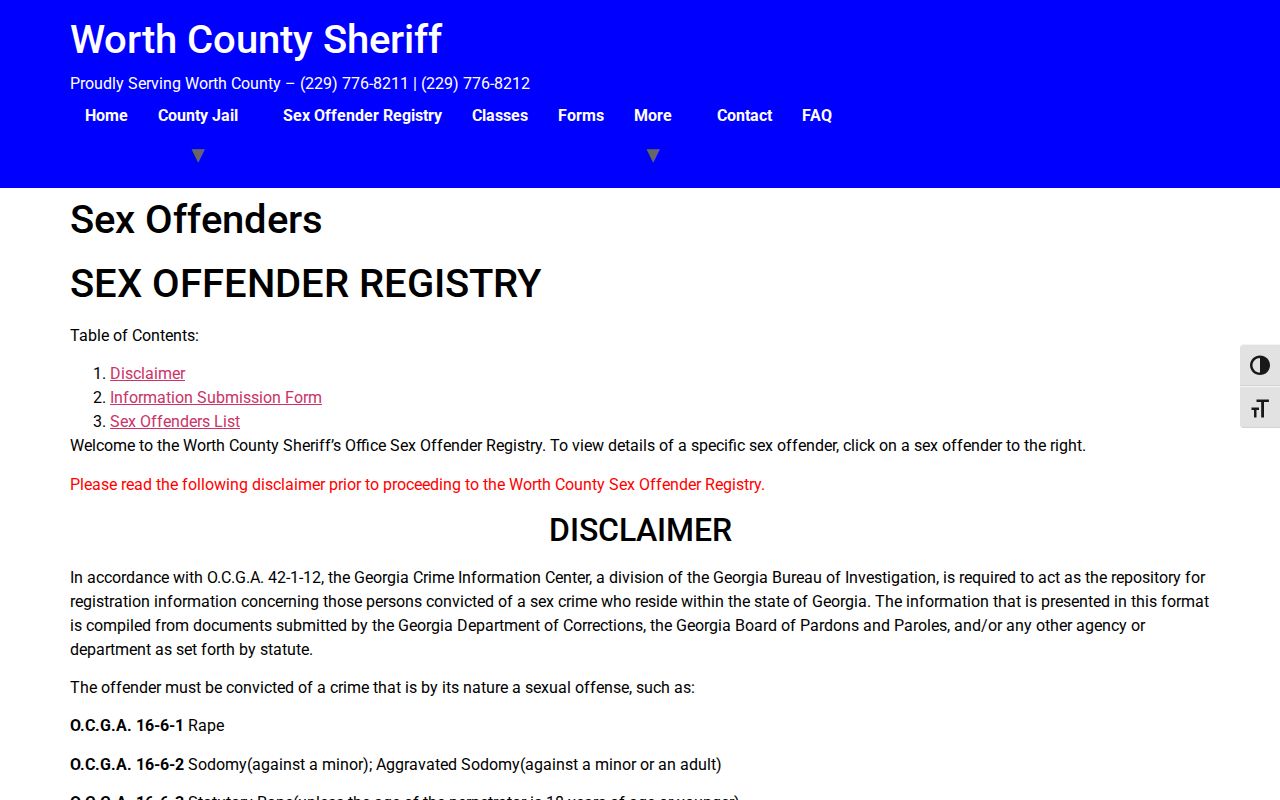
The Worth County registry page is shown below.
Official Registry Sources
State: GBI registry information
Search: Georgia public registry
Local: Worth County Sheriff registry
Worth Jail Release Proof
For a Worth County Jail release, begin with the Sheriff's inmate database. Current Inmates checks present county custody. Inmates by Booking Date with “Include Previous Inmates In Search” is the local release-oriented path. The sentence and history views may contain a release date or prior release date.
If online fields are missing, contact jail operations or request the booking and release record. The court docket may show bond, dismissal, time served, sentence, transfer, probation, or another legal reason. None of those facts should be inferred from registry presence alone.
Registry Images and Booking Photos
A registry result may display an image, but that image serves the registry record. Worth County booking photographs follow a separate Sheriff's process. The open-records page requires a booking-photo affirmation form, reflecting Georgia's special rule in O.C.G.A. § 35-1-19.
Do not assume that a registry image proves the date or appearance of a particular jail booking. If the official booking photograph is needed, identify the exact booking and submit the required county form. GDC may also display a state offender photograph when available, but that applies only to a state offender record.
Courts Define Registration Duties
The legal duty flows from the governing offense, judgment, and Georgia law, not from a casual label. Worth County Superior Court handles felony cases, while State Court handles misdemeanors and traffic cases within its jurisdiction. The case record may explain the conviction, sentence, restrictions, or later court action.
Use the Clerk of Courts for the official disposition. Do not speculate when a registry search is blank. The name may differ, the person may not have a registration duty, the jurisdiction may be elsewhere, or the record may require correction by the responsible agency.
Compliance Is Not Release Proof
Compliance describes whether registry duties are being met according to the published system. It does not establish the full release date, supervision term, or absence of another warrant. A parolee may also be a registrant, but parole status comes from the State Board and DCS. A probationer may have separate court and DCS records.
For a current custody question, use the holding agency. For a past county release, use the Sheriff and court. For state custody, use GDC. This division keeps a narrow registry tool from being misread as a broad criminal or custody database.
Worth Registry Address Changes
Registry information can change when a registrant moves, enters custody, leaves custody, or reports another event that affects the published record. A search result is a snapshot from the registry source. It should be dated and compared with the local Sheriff's information when Worth County is the listed jurisdiction.
A county address does not show when the person was released from jail. The release date belongs to the custody record. If a recent move or custody label seems inconsistent, ask the registry office about the registry entry and jail operations about the booking. Each system should explain only the facts it controls.
Correct Worth Registry Information
Questions about an official registry entry should go to the agency responsible for it. A public search cannot correct a name, image, address, offense description, or compliance label. Keep a copy of the result, note the search date, and identify the exact field believed to be wrong.
Georgia record restriction under O.C.G.A. § 35-3-37 is a separate process and does not automatically answer registry duties. A court order or criminal-history restriction should not be assumed to remove a lawful registration requirement. Use the court, GBI, and Sheriff's registry channel for the distinct records each maintains.
Worth Registry Search Dates
Record the day each registry, jail, and court search was run. Status can change, so dated notes help explain why two official sources displayed different facts at different times.