
Worth County Release Date Types
A projected date is an estimate or computed endpoint based on facts known now. An actual release date records the custody event that occurred. Worth County Jail, Georgia Department of Corrections, and the State Board of Pardons and Paroles use different date terms because each controls a different part of the process.
A pretrial detainee usually has no scheduled release date. The person may leave after bond, dismissal, a judge's order, or transfer. A county-sentenced inmate may have a release based on sentence expiration less a lawful earned-time allowance. A state prisoner has a GDC sentence computation. If parole is considered, the Board may add a Tentative Parole Month. None of those dates alone proves the person has walked out of custody.
| Date term | What it means | Best source |
|---|---|---|
| County release date | End of Worth jail custody or prior release event | OffenderIndex, jail records, court |
| Maximum Release Date | GDC endpoint if the full sentence is served, apart from parole | GDC record |
| Tentative Parole Month | Expected Board final-review month | Parole Board lookup |
| Actual release | Completed custody change | Controlling agency record |
Find a Worth County Inmate Release Date
Start with custody type. The county jail route is right for a Worth County booking or local sentence. GDC is right for a state sentence, including a person moved from the jail after court. The Board is right for parole planning. BOP and ICE records apply to federal or immigration custody. A release from one agency can be a transfer into another.
- Search the Worth County OffenderIndex Current Inmates tab. A current match means the person remains booked in the county source.
- If no current match appears, open Inmates by Booking Date, choose a suitable range, and select “Include Previous Inmates In Search.”
- Expand the matching record and check the sentence and history fields for a release date or prior release date.
- For state custody, search the GDC Offender Query by name, GDC ID, case number, or available description fields.
- For parole planning, use the Board's TPM lookup. Do not turn a month into an exact date.
- Confirm uncertain results with Worth County Jail operations, GDC Inmate Records, or the court that entered the sentence.
The Worth County release-record guide explains how to request the jail record when the online fields are missing. Match age, charge, case, booking date, and other identifiers before treating a result as the right person.
Worth County Jail Sentence Dates
O.C.G.A. § 42-4-7 addresses county inmate records and provides that a county inmate sentenced to confinement is released when the sentence expires, less applicable earned-time allowances. This is a county-jail rule. It should not be substituted for GDC sentence computation or parole eligibility.
Worth County's OffenderIndex has configured sentence and history subgrids. Those fields can include release date and previous release dates. The live interface also supports former-inmate searching. Yet the county does not promise a fixed online retention period. Its by-date tool defaults to about the last month, but that is only an interface setting, not a records-retention rule. Older or incomplete entries should be checked through the Sheriff's open-records channel.
For a pretrial detainee, do not subtract days from a charge or bond amount. No sentence has necessarily been imposed. The court controls bond and legal disposition, while the jail controls the custody log. A transfer entry may also mean the person left Worth County Jail but did not enter the community.
Worth GDC Maximum Release Date
Georgia rules define Maximum Release Date as the date an inmate would leave Department of Corrections custody if the entire sentence were served, exclusive of parole decisions. Sentence computation may account for the sentence start, jail-time credit when applicable, special instructions, sentence length, non-running time, and credits permitted under the governing rules. This is more precise than a generic projected date.
The GDC search offers active and inactive scopes and a “Released In The Past 15 Days” option. A result may display sentence information, facility status, and release-related fields. The online database is not final proof. GDC asks users to verify information with Inmate Records and Information when accuracy matters.
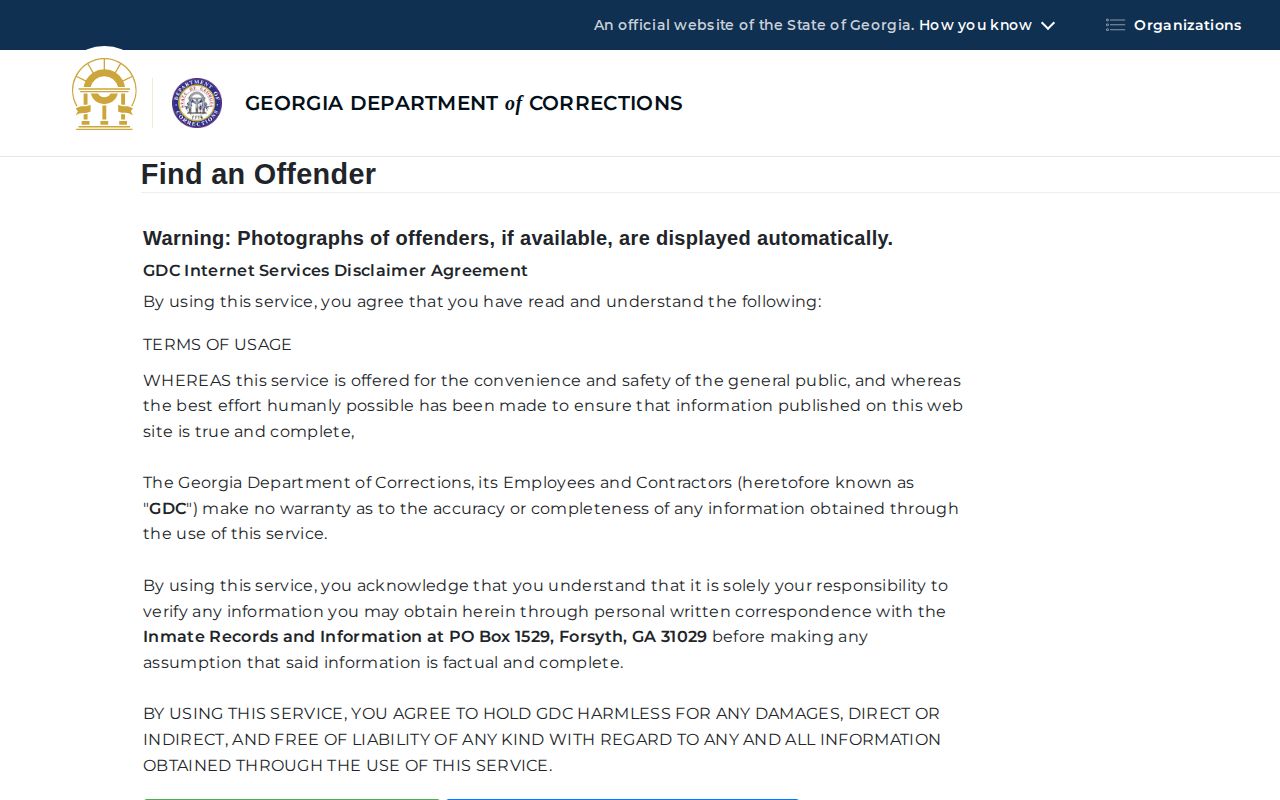
The official Georgia offender query is shown below. Its state release filter applies to GDC records, not routine Worth County bond releases.
Worth County Parole Month Meaning
Georgia's Tentative Parole Month is a planned month and year for possible parole placement. The State Board conducts final review at that point and may set a release date. The Board can change a prior decision up to release. Conduct, program prerequisites, new legal material, or another Board vote can affect the outcome.
This distinction is Worth County's key release-date quirk. A Maximum Release Date answers when the state sentence ends if fully served without parole. A TPM answers when final parole review is expected. The first is not a promise that custody will last until that day, and the second is not a promise of release. A final date, GDC status, parolee database entry, or official response is stronger evidence.
Georgia Time Rules for Worth Releases
Georgia should not be reduced to a claim that each prisoner serves 85 percent. GDC's sentence-computation rule describes straight-time service for crimes committed on or after January 1, 1984, while earned-time provisions relate to offenders entitled under earlier law. County inmates have a separate statutory framework. Parole eligibility is another distinct calculation.
O.C.G.A. § 42-9-45 supplies general parole-eligibility thresholds. The Board says many eligible felony inmates receive consideration after one-third of the sentence, but consideration is discretionary. It does not grant release. O.C.G.A. § 17-10-6.1 creates serious violent felony restrictions. The Board explains that qualifying non-life prison terms for offenses committed on or after January 1, 1995 require 100 percent service.
Life sentences and other exceptions need the judgment, offense date, and controlling statute. A public search result cannot replace that record. Use the sentence order to identify the legal term, GDC for state computation, and the Board for parole status.
Why Worth Release Dates Change
A date can move because the source data or legal calculation changes. Some events alter the sentence computation. Others change where the person goes on the planned day. The controlling agency should confirm the current result.
| Factor | Possible effect | Confirm with |
|---|---|---|
| Jail-time credit or correction | Changes sentence start or end | Court and GDC |
| Non-running or escape time | Extends the computed term | GDC records |
| Parole grant, denial, or deferral | Changes the planned custody path | Parole Board |
| Program or conduct issue | May affect parole review | Board and GDC |
| Court order | Corrects, ends, or changes custody authority | Worth County court |
| Detainer or hold | Transfers the person to another agency | Jail and receiving agency |
A county release can therefore be real without being a release to the street. GDC, another county, BOP, ICE, or the U.S. Marshals Service may accept custody. Ask whether the date marks release from a specific agency or release from all confinement.
Confirm a Worth County Release
Use the agency controlling custody at that moment. Worth County Jail operations can address county custody. The Clerk of Courts can provide a bond order, sentence, dismissal, or disposition. GDC Inmate Records can verify a state computation. The Board and DCS can verify parole status. For pending custody changes, the VINELink Release Check can provide an alert when the participating agency sends an update.
VINELink is not a complete historical archive, and an alert can lag. Compare it with the jail release field, GDC status, parolee record, or court document. If no online record resolves the issue, make a narrow records request that supplies the person's full name, booking period, case number if known, and the exact release field sought.