
Worth County Parole and Probation
Parole and probation both allow a person to live in the community under stated rules, but they arise at different points. The State Board of Pardons and Paroles decides whether an eligible person may leave Georgia Department of Corrections custody on parole. The Georgia Department of Community Supervision, commonly called DCS, then supervises parolees in the community. A Worth County court may instead sentence a person to felony probation. DCS supervises that order even if the person never entered state prison.
The distinction controls where to look. A parolee can appear in the Board's parolee database. Someone awaiting a parole decision may have a Tentative Parole Month, or TPM, in the Board lookup. A probationer is best confirmed through the sentencing order and DCS. Misdemeanor probation can involve the local court and its assigned provider, so it should not be assumed to appear in the state parole database.
| Point | Parole | Probation |
|---|---|---|
| How it begins | Board authorizes release from prison | Court enters a sentence or order |
| Main public proof | Parolee database and Board record | Court disposition and supervision record |
| Community agency | Georgia DCS | Georgia DCS for felony cases |
| How it ends | Discharge, expiration, or Board action | Completion, discharge, or court action |
Verify Worth County Post-Release Supervision
Begin by deciding whether the person left a county jail, a state prison, or another system. A routine bond release from Worth County Jail does not create parole. A person released after a felony prison sentence may be on parole. A court sentence may place someone on probation after time served or instead of more confinement. The Worth County released-inmate search paths can confirm the custody event before supervision is checked.
- Use the State Board's Parolee Database for someone believed to be out of prison on parole.
- Compare the full name and available identifiers. Do not rely on a similar name alone.
- For someone still in GDC custody, use the Inmate TPM Lookup. Treat the month as planning, not proof of release.
- For probation, request the sentencing or probation order from Worth County Superior or State Court, based on the case.
- Use the DCS field-office locator to identify the office assigned to supervision.
- When online results conflict, confirm with the Board, DCS, the court clerk, or the agency holding the official record.
A blank result has several possible meanings. The spelling may differ, the person may be on probation rather than parole, the term may have ended, or another state may control the case. It may also mean the person remains confined. Check GDC custody status before drawing a conclusion.
Worth County Parole Decision Process
Georgia does not publish an ordinary county-by-county calendar that works like a court hearing docket. The Board describes a file-based process. Eligible GDC inmates receive consideration without filing an application. Staff gather legal and personal-history material, a hearing examiner reviews guideline factors, and Board members vote independently. A majority is required. A non-life case may receive a TPM or a denial. Life cases follow a different grant-or-deny framework.
The practical public status routes are the Board's parole process page, TPM lookup, parolee search, and FAQ. A TPM is the month in which final review is expected. It can change. Conditions, conduct, program work, new legal facts, or another Board decision may affect it before release. Only the final action and later custody or parolee status show what actually occurred.
Worth County Parole Eligibility Rules
Georgia eligibility rules depend on the sentence and offense. O.C.G.A. § 42-9-45 provides general timing thresholds. The Board explains that many parole-eligible inmates reach consideration after one-third of a sentence, but eligibility only permits review. It does not require a grant. Serious violent felony sentences can follow stricter rules under O.C.G.A. § 17-10-6.1. For qualifying non-life offenses committed on or after January 1, 1995, the Board explains that the prison term must be served in full.
Life sentences and repeat-offender rules require their own analysis. The Board states that denied non-life cases receive later review within stated policy intervals, while denied life cases are reconsidered at intervals not exceeding eight years. These rules explain why two people with similar sentence lengths can have different parole paths. The judgment, offense date, sentence terms, and Board record must be read together.
Worth County Supervision Through Tifton
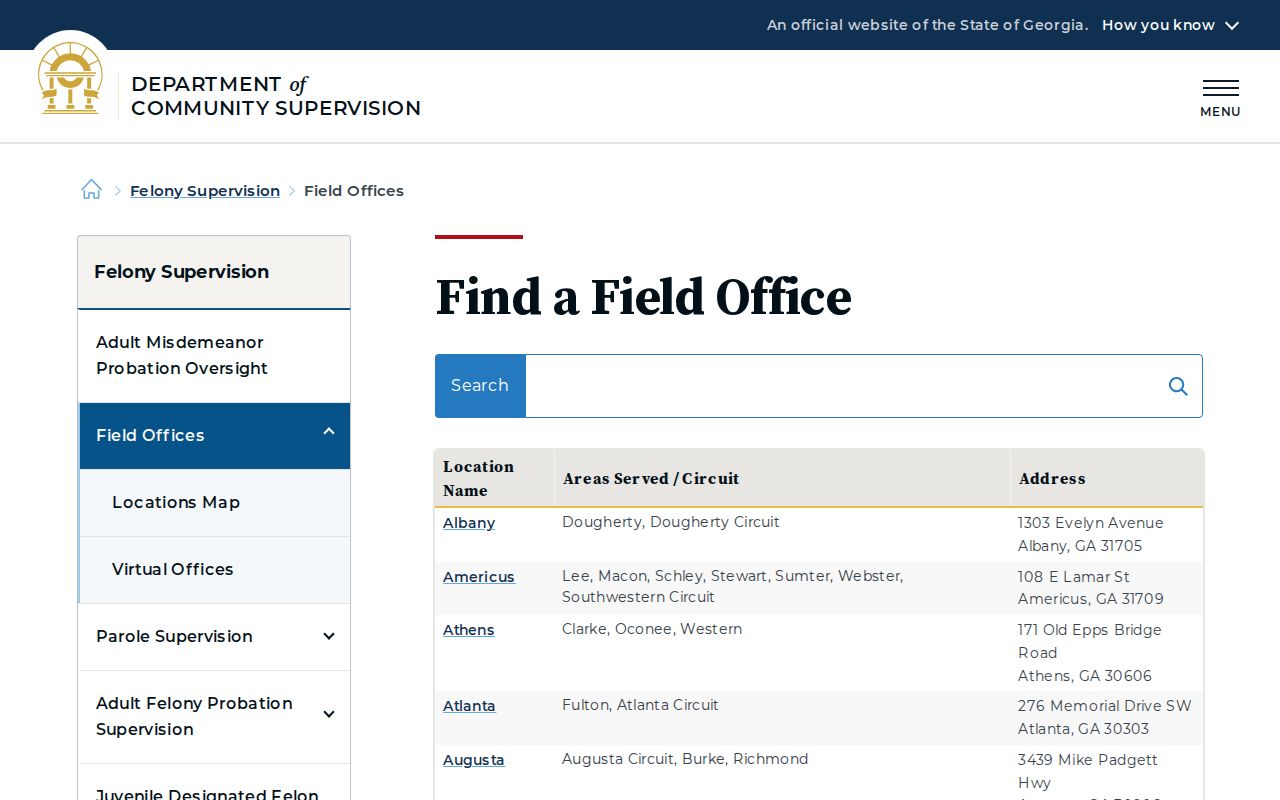
Worth County is served by the Georgia DCS Tifton field office. This is a key local distinction. Once a person is under felony probation or parole supervision, the Worth County Jail is usually not the office managing reporting, permissions, or supervision status. The DCS assignment controls, and an individual case may have instructions that are not shown on a public page.
Georgia DCS Tifton Field Office
Address: 115 South Davis Avenue, Tifton, GA 31694
Statewide phone: (678) 783-4337
Coverage: Irwin, Tift, Tifton Circuit, Turner, and Worth
The official DCS field-office page is the source for office routing. The screenshot below shows the state locator used to identify the office serving Worth County.
Worth County Violations and Warrants
Supervision conditions are the rules attached to release or sentence. They can include reporting, lawful conduct, approved residence, travel limits, program participation, and payment terms stated in the order. The exact conditions come from the parole certificate, probation order, or supervising officer. A violation is an alleged failure to follow those terms. It is not the same thing as a new conviction.
An absconder is a supervised person alleged to have stopped reporting or left supervision without authorization. No official Worth County sheriff absconder list was found in the reviewed sources. Do not infer warrant status from a missing database entry. Check the parolee database, DCS or Board contact, Worth County court dockets, and sheriff warrant records. A Board warrant can start parole revocation procedures, while a court may handle probation revocation.
VINELink is useful for custody changes after an arrest, but it is not a complete supervision database. If a person is taken into custody on a violation, a VINE alert may report the custody event. The court or Board record explains what happens to supervision.
Worth Booking-Photo Affirmation Rules
Worth County has an unusual local record step that can matter after release. The Sheriff's Office requires a booking-photo affirmation form with a request for a booking image. The requester affirms that the photograph will not be removed from a publication or website in exchange for payment or other consideration. This process comes from Georgia's booking-photo limits and is separate from parole or probation verification.
The form does not show whether a person is supervised. It also does not prove the reason for release. Use the Board, DCS, and court paths for supervision. Use the Sheriff's open-records channel only when the booking photo or county custody record is actually needed.
Worth County Supervision Discharge
Supervision ends through a formal event, not simply because a name disappears online. Parole may end when the term expires or the Board issues a discharge. Probation may end upon completion, early termination, or another court order. A revocation can instead return the person to custody or change the terms. The controlling document is the discharge, Board action, or court order.
For parole, verify the end status with the Board or DCS when the database is unclear. For probation, request the case docket and completion or discharge entry from the proper Worth County court. A former supervisee may no longer appear in a current-status tool even though older court and custody records still exist. Keep the custody record, supervision record, and legal disposition separate.